

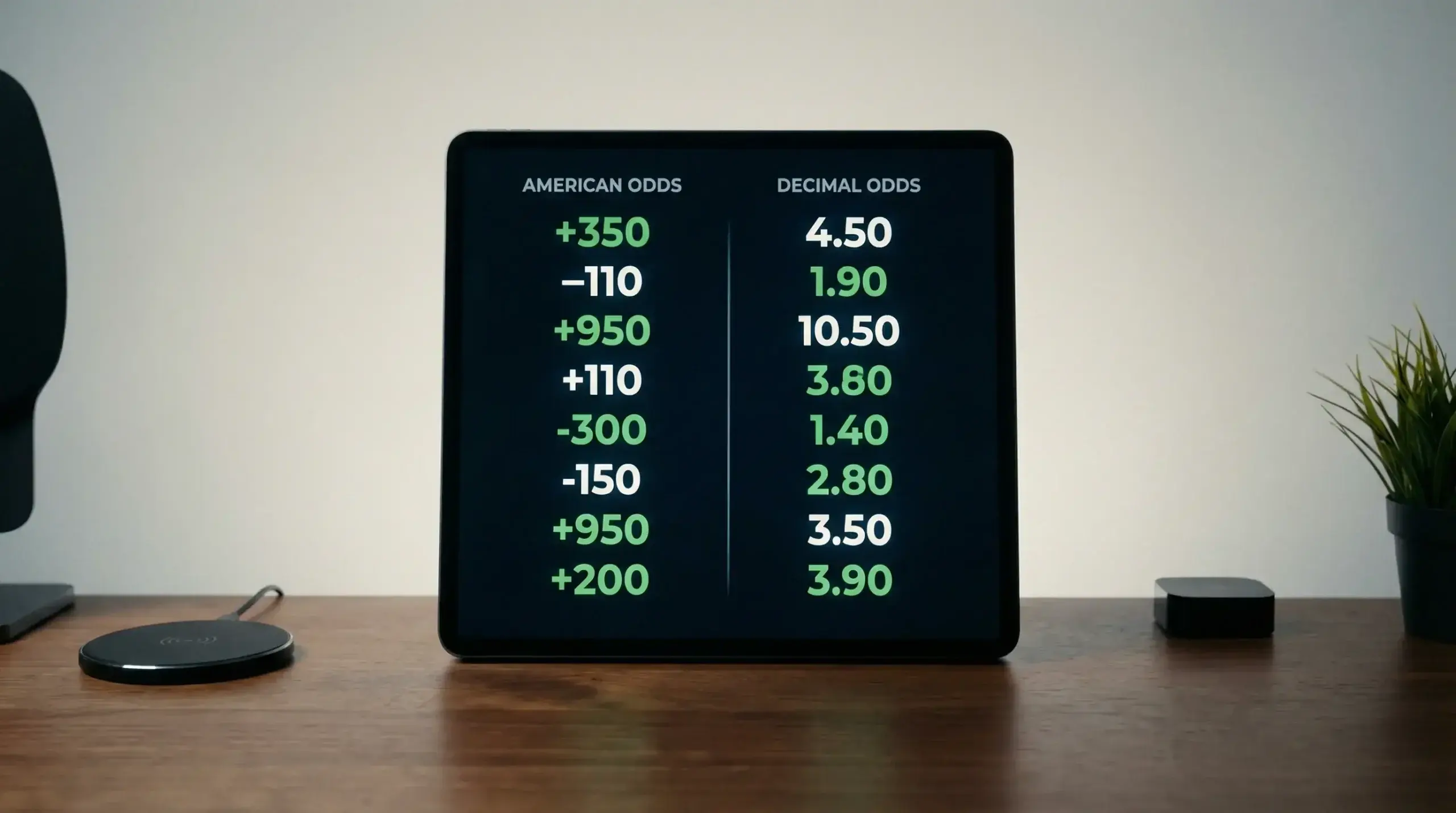
The first time I tried to follow an American MLB tipster’s picks, I stared at “-150” and “+130” for a solid five minutes trying to work out what I was actually being asked to risk. American odds are the native language of baseball betting, and nearly every piece of MLB analysis you find online — from podcasts to data models — uses them. As a UK bettor working in decimal odds, you need a reliable translation method or you will constantly second-guess whether a recommended bet is actually worth taking at the price your bookmaker offers.
The good news: the conversion formulas are simple, and once you have used them a dozen times, the translation becomes automatic. The even better news: understanding both formats gives you an analytical edge because you can consume American-sourced research directly without waiting for someone to localise it.
The Two Formulas: Positive and Negative American Odds
American odds split into two camps — positive numbers for underdogs and negative numbers for favourites — and each requires a different conversion formula. This confused me for weeks until I realised the logic behind it.
Negative American odds tell you how much you need to stake to win 100 units. So -150 means you stake 150 to win 100. To convert to decimal: divide 100 by the absolute value of the American odds, then add 1. For -150: 100 / 150 = 0.667, plus 1 = 1.667 in decimal. That means a GBP 10 bet returns GBP 16.67 total (your stake plus GBP 6.67 profit).
Positive American odds tell you how much you win on a 100-unit stake. So +130 means a 100-unit stake returns 130 in profit. To convert to decimal: divide the American odds by 100, then add 1. For +130: 130 / 100 = 1.30, plus 1 = 2.30 in decimal. A GBP 10 bet at 2.30 returns GBP 23.00 total.
The formulas in short:
Negative American odds: Decimal = (100 / |American odds|) + 1
Positive American odds: Decimal = (American odds / 100) + 1
I keep a small conversion table saved on my phone for the most common MLB odds ranges. -110 converts to 1.909, -120 to 1.833, -150 to 1.667, +100 to 2.00, +120 to 2.20, +150 to 2.50. After a few weeks of active use, these numbers become second nature and you stop needing the table entirely.
Worked Examples With Real MLB Lines
Theory is useful, but nothing cements conversion like running through actual game scenarios. Let me walk through a typical MLB slate.
Suppose the Yankees are listed at -160 (moneyline favourite) against the Orioles at +140. Converting the Yankees: 100 / 160 = 0.625, plus 1 = 1.625 decimal. Converting the Orioles: 140 / 100 = 1.40, plus 1 = 2.40 decimal. Your UK bookmaker might list the same game as Yankees 1.63, Orioles 2.38. The slight differences reflect the bookmaker’s own margin calculations, but you can immediately see whether the prices are in the right neighbourhood.
Now consider a run line: Dodgers -1.5 at -110, Padres +1.5 at -110. Both sides at -110 convert to 1.909 decimal. This is a standard “pick’em” run line where the spread is 1.5 runs and the book prices both sides nearly evenly. If your UK bookmaker offers the same run line at 1.90 on both sides, the margin is slightly higher. If they offer 1.95, it is slightly lower. These differences look small on one bet but compound meaningfully across a season. Moneyline favourites in MLB win roughly 58-62% of the time, but run line favourites at -1.5 win less frequently because the team must win by two or more runs — the conversion helps you see whether the adjusted price compensates for that extra hurdle.
For totals: a game total of 8.5 with the over at -105 and the under at -115. Over converts to (100/105) + 1 = 1.952. Under converts to (100/115) + 1 = 1.870. Notice the under is priced shorter — the book expects the under to hit more often in this particular game, probably because two strong starters are pitching. Your UK bookmaker might display these as Over 1.95, Under 1.87. If you have a model suggesting the true probability of the under is 55%, you need odds of at least 1.818 to break even (1/0.55). The bookmaker’s 1.87 clears that threshold, so the under carries positive expected value on your numbers.
From Decimal Odds to Implied Probability
Converting odds to implied probability is the step that separates casual bettors from analytical ones. Decimal odds make this calculation trivially easy: divide 1 by the decimal odds. At 1.625 decimal, the implied probability is 1/1.625 = 61.5%. At 2.40 decimal, it is 1/2.40 = 41.7%.
Notice that 61.5% + 41.7% = 103.2%. That extra 3.2% above 100% is the bookmaker’s margin, also called the overround or vigorish. The margin is the house’s built-in edge, and it is always present. Lower margins mean fairer prices for the bettor. A 3% overround on an MLB moneyline is competitive; 6% or higher means you are paying a steep tax on every bet.
I use implied probability as a screening tool before placing any bet. If my model gives a team a 58% chance of winning and the bookmaker’s implied probability is 55%, there is a 3% gap that represents potential value. If the bookmaker’s implied probability is already 60%, the market has priced the team higher than my model, and I pass. This discipline requires converting every line I evaluate into implied probability, which is why fluency in the decimal format — and the conversion from American odds when consuming US-sourced analysis — is not optional for serious MLB betting from the UK.
One final wrinkle: fractional odds, the traditional UK format, are almost never used for MLB. If you encounter them, converting to decimal is straightforward — add 1 to the fraction expressed as a decimal. 5/4 fractional = 1.25 + 1 = 2.25 decimal. But in practice, decimal is the universal language for MLB beat bets analysis across UK platforms, and switching your default format to decimal before your first baseball bet is the single easiest improvement you can make to your workflow.
