

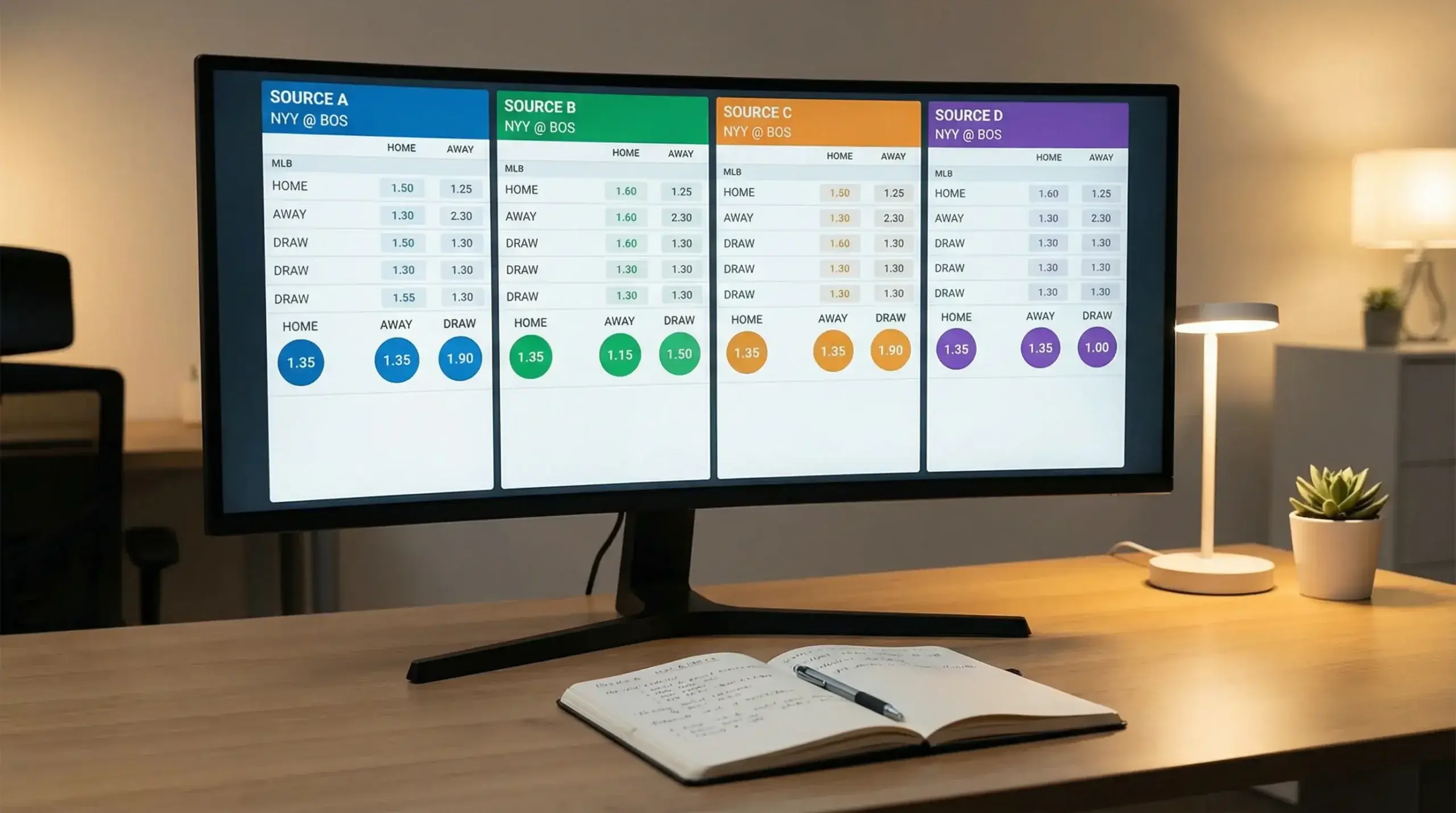
The single laziest edge in all of sports betting is line shopping, and most people still do not bother. I say “laziest” as a compliment — it requires no modelling skill, no sabermetric knowledge, and no understanding of platoon splits. You simply compare the price on the same bet across multiple bookmakers and take the best number. Over a full MLB season of 2,430 games, those small price differences compound into a material improvement in ROI that costs you nothing but a few extra minutes per bet.
I maintain accounts with four UK-licensed operators specifically for MLB betting. On any given game, the moneyline price for the same team can vary by 0.05 to 0.15 in decimal odds between operators. That sounds trivial on a single wager, but across 300-400 bets per season, consistently capturing the best price is worth roughly 2-3% additional return on investment — the difference between a marginal season and a profitable one.
Why a 0.05 Odds Difference Matters Over a Full Season
Let me make this concrete. Suppose you place 350 MLB bets in a season at an average stake of GBP 20. If you consistently get odds that are 0.05 better than the average available price, your total return increases by 0.05 x 20 x 350 x (your win rate). At a 53% win rate, that is 0.05 x 20 x 185.5 (wins) = GBP 185.50 in additional profit from doing nothing more than checking a second screen before clicking “place bet.”
The compound effect over multiple seasons is even more significant. That GBP 185 rolls back into your bankroll, increasing your unit size, which increases the absolute value of future line-shopping gains. It is a flywheel that accelerates the longer you maintain the discipline. Bettors who line-shop religiously for five years operate at a structural advantage over those who stick with a single bookmaker — the cumulative difference can be thousands of pounds.
The psychological benefit is underrated too. Knowing you have taken the best available price removes the regret factor when a bet loses by a narrow margin. If you took 1.90 when 1.95 was available elsewhere and the bet loses, that 0.05 stings. If you took the 1.95 and it still loses, you know you extracted maximum value from the opportunity. Removing post-hoc regret improves decision quality on subsequent bets.
Comparing MLB Odds at bet365, Betfair, and Ladbrokes
Tim Miller, the UK Gambling Commission’s executive director, has spoken about the importance of protecting the regulated market that Britain has built since the 2005 Act. That regulated market gives UK bettors access to multiple licensed operators competing on price, which is the structural foundation that makes line shopping possible.
In practice, MLB odds across UK operators tend to cluster within a narrow range but rarely converge exactly. One operator might price a favourite at 1.68 while another offers 1.72 on the same team. The spread on the underdog side is often wider — you might see 2.25 at one book and 2.35 at another. That 0.10 difference on the underdog is proportionally more valuable because underdog bets pay out less frequently and the return per win is larger.
William Hill commands about 37.8% of PPC click share in UK sports betting, with bet365 at around 16.2%. Market share in advertising does not correlate with the best MLB odds — in my experience, the operator with the biggest billboard is not consistently the one offering the sharpest price. Smaller or mid-tier operators sometimes offer better MLB lines because they are more willing to accept risk on lower-volume markets to attract niche bettors.
I recommend keeping a simple spreadsheet or using your phone’s notes app to record the best-available price from at least three operators for each bet you plan to place. The process takes two to three minutes per game. If you are evaluating five games on a typical night, that is ten to fifteen minutes of price comparison that generates hundreds of pounds of annual value.
Odds Comparison Tools Available to UK Bettors
Manual line shopping across four or five operator apps is effective but tedious. Odds comparison sites streamline the process by aggregating prices from multiple bookmakers on a single page, updated in near-real-time.
Several free odds comparison tools cover MLB markets, though coverage depth varies. The best ones display moneyline, run line, and totals prices from a dozen or more operators, with the best available price highlighted. Some include historical line data, showing how the odds have moved since opening, which adds a line-movement analysis layer on top of the price comparison.
One limitation to be aware of: most comparison tools pull data from the operators’ APIs, and there can be a short delay between the live price on the operator’s site and the price displayed on the comparison tool. During periods of rapid line movement — after a lineup announcement or injury news — the comparison tool might show a price that is already gone by the time you click through. I use comparison tools for initial screening and always verify the exact price on the operator’s platform before placing the bet.
Exchange betting platforms offer another dimension. Rather than accepting a fixed price from a bookmaker, exchanges let you bet against other punters, often at better odds because there is no built-in bookmaker margin — only a small commission on winning bets. MLB liquidity on exchanges is lower than for football, but for popular games and playoff matchups, exchange prices can beat traditional bookmaker odds by 3-5%. Incorporating exchange pricing into your line-shopping routine widens the range of available prices and increases the likelihood of finding a genuinely superior number for every MLB bet you place.
