

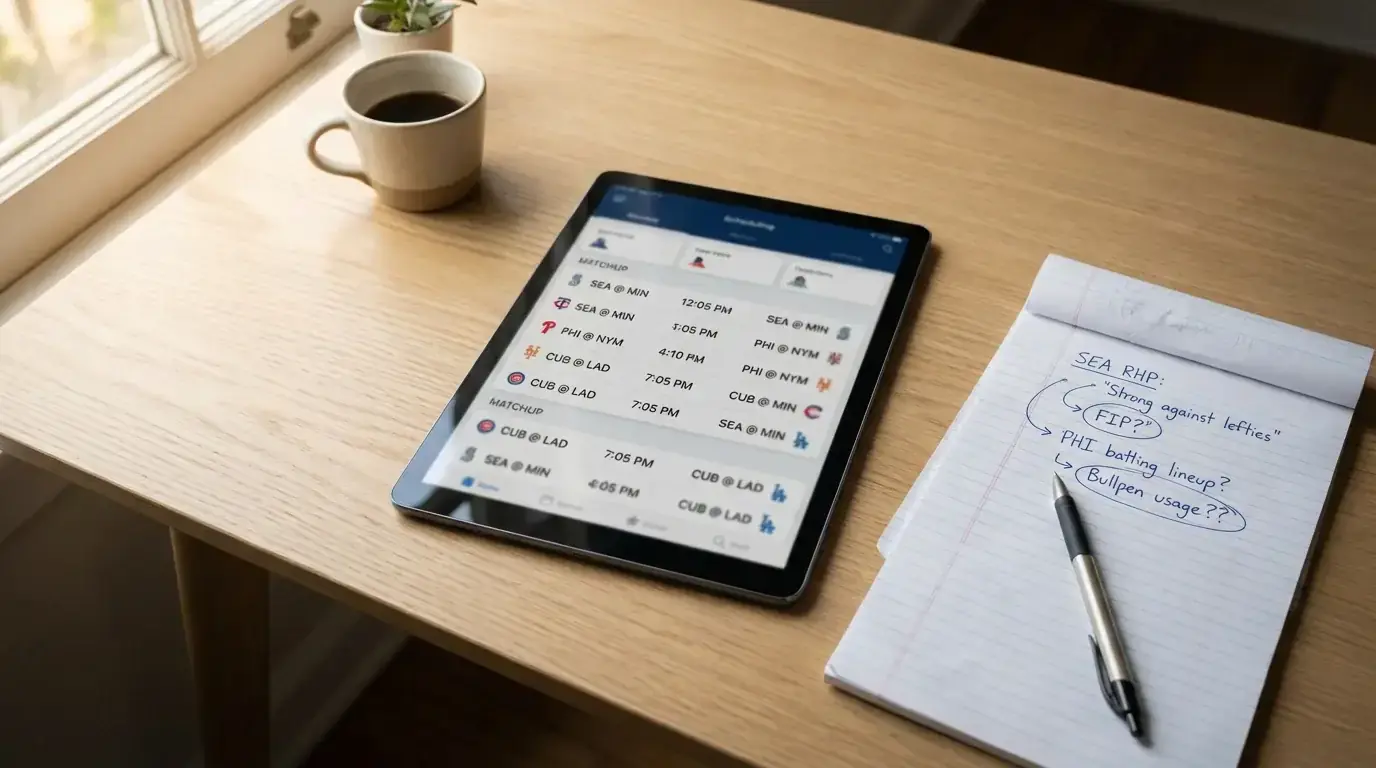
Every morning during baseball season, dozens of websites publish their “MLB predictions today” — computer picks, expert selections, consensus ratings, confidence scores. I used to read them like gospel. Now I read them like a scouting report on the market itself: useful context, but never a substitute for my own analysis. The difference between a bettor who follows picks and a bettor who evaluates picks is the difference between renting someone else’s edge and building your own.
The Pre-Bet Checklist: What to Verify Before Backing a Pick
Before I place any MLB bet — whether it originated from my own model or from a tipster’s recommendation — I run it through the same five-point verification process. The checklist takes about five minutes per game and has saved me from more bad bets than any single analytical improvement I have ever made.
First: confirm the starting pitchers. Pitching changes happen frequently, and a pick based on Pitcher A is worthless if Pitcher B takes the mound instead. I check confirmed probables no earlier than three hours before first pitch, when the information is reliable. Second: check the lineup. If a key hitter is sitting, the offensive projection changes. Late scratches can move the line by 5-10 cents on the moneyline, and a pick made before the lineup announcement might not account for that shift.
Third: verify the odds. A pick that was +EV at 2.10 might no longer be +EV at 1.95 if the line has moved since the recommendation was published. I never take a pick at any price — I take it at a price that still represents value according to my assessment. If the line has shortened beyond my value threshold, I pass even if the underlying analysis is sound. Fourth: check the weather. A totals pick made twelve hours ago might not account for a wind-direction change that materialised in the afternoon forecast. Temperature shifts can also affect run environments in ways that alter the value proposition. Fifth: review the bullpen status. Both teams’ bullpen usage over the past 48 hours tells you whether the late-inning matchup favours the pick or undermines it. With 2,430 regular-season games generating daily data, the bullpen situation can shift dramatically from one evening to the next. A pick made based on full bullpen availability becomes questionable when three key relievers have thrown 25+ pitches in the past two days.
This checklist is not glamorous, but it is the difference between informed betting and lazy tailing. Every pick is a hypothesis. The checklist tests that hypothesis against current conditions.
Red Flags and Green Flags When Evaluating MLB Tipsters
The internet is full of MLB tipsters. Some are excellent. Most are mediocre. A few are outright fraudulent. After nine years in this space, I have developed a reliable set of signals for sorting them.
Green flags: a publicly verifiable track record spanning at least one full MLB season (minimum 500 tracked picks); flat-stake ROI reported at closing-line odds, not opening-line odds; transparent methodology that explains why a pick was made, not just what the pick is; willingness to show losing streaks alongside winning ones; and a consistent unit-sizing approach that does not magically increase stakes on winners and decrease them on losers.
Red flags: track records that only show the last 30 days or cherry-pick the best month; “guaranteed” picks or claims of 70%+ win rates (unsustainable in MLB over any meaningful sample); upselling premium picks by teasing free picks that suspiciously always win; vague reasoning like “this team is due” or “I have a feeling”; and any tipster who refuses to disclose historical results or changes their published record after the fact. I have also learned to be wary of tipsters who dramatically increase their claimed unit size on winners — if someone says they bet 5 units on a winner but only 1 unit on their losses, the reported ROI is meaningless without independent verification of the actual stakes.
The best MLB tipsters I follow operate more like analysts than salespeople. They explain their process, acknowledge uncertainty, and present their picks as +EV opportunities rather than guaranteed winners. The long-term thinking principle — avoiding the impulse to chase losses over a long season — applies to tipster selection as much as it applies to staking.
Building Your Own Daily MLB Analysis Routine
The ultimate goal is not to find the perfect tipster — it is to develop your own daily process that generates consistent, independent evaluations. My routine has evolved over years, but the structure has remained stable for the last four seasons.
I start each evening around 17:00 BST by scanning the full slate. I note the starting pitchers, identify the games with the strongest pitching mismatches, and flag any park-weather combinations that warrant closer analysis. This initial scan takes 15-20 minutes and narrows a 15-game slate down to 5-7 games worth evaluating in detail.
Next, I run those 5-7 games through my model, which generates win probabilities and expected totals based on pitcher metrics, team offence, park factors, and recent form. I compare the model’s output to the current market odds and identify any gaps of 3% or more in implied probability. Games that clear this threshold become candidates for a bet.
Then I apply the pre-bet checklist described above: verify pitchers, check lineups, confirm odds, check weather, review bullpens. By 20:00-21:00 BST, I have a final shortlist of 1-4 bets for the night. The entire process — scan, model, verify, select — takes about 90 minutes. It is repeatable, scalable, and independent of any external tipster. That independence is the point. Tipsters can supplement your process, but they should never replace it. Building your own routine is the single most valuable investment you can make in your MLB betting career.
