

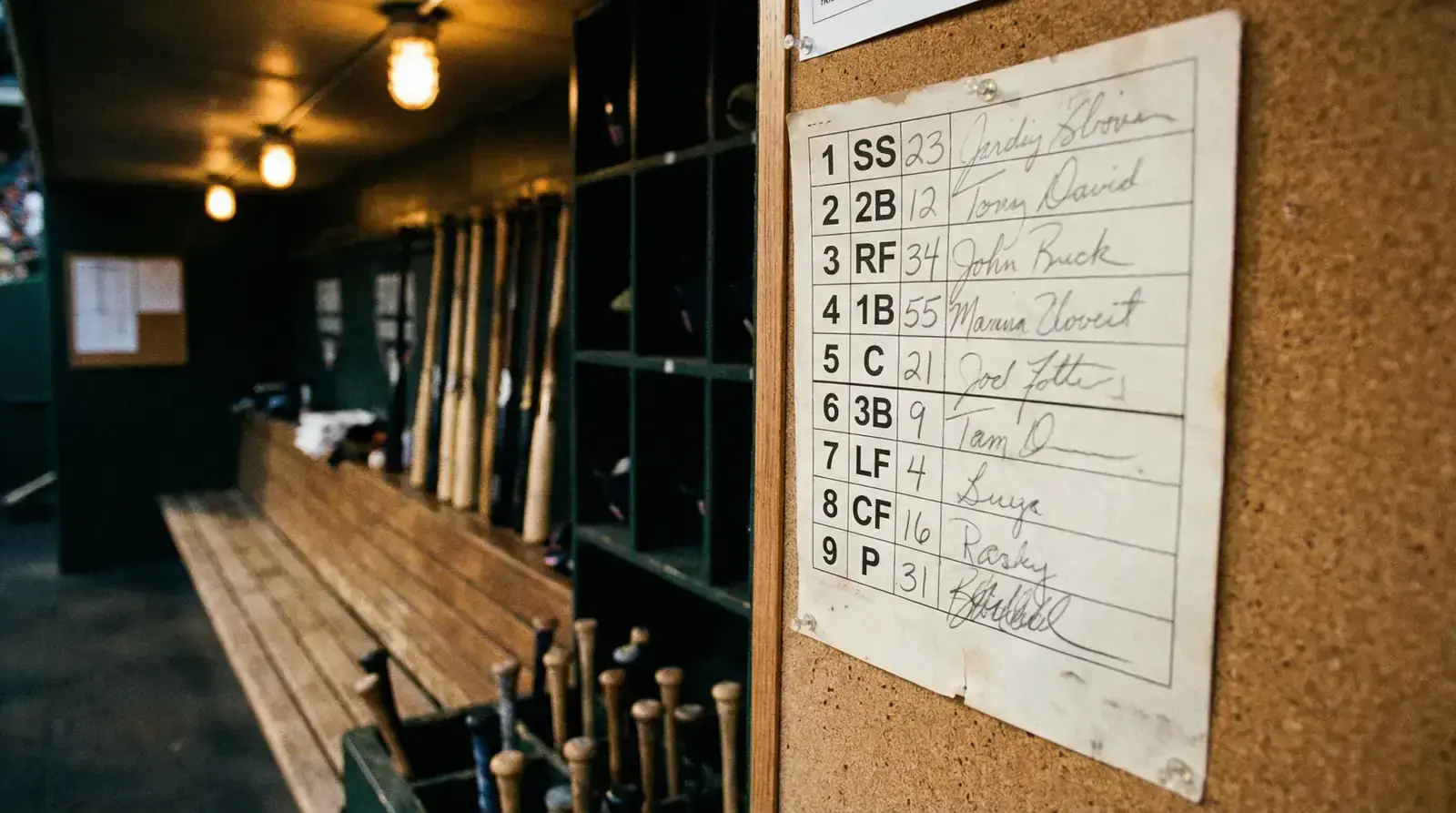
Pitching gets all the pregame attention from bettors, and for good reason — the starting pitcher is the single largest input into any MLB line. But lineups matter too, often more than the market acknowledges. I have seen moneylines shift 10-15 cents on nothing more than a lineup announcement, and I have seen the market fail to move at all when a key hitter was quietly scratched from a lineup posted ninety minutes before first pitch. Those gaps between information and price are where lineup analysis earns its keep.
Why the Top of the Order Matters for Moneyline and Totals
Baseball batting orders are not created equal. The first four spots in the lineup — the leadoff hitter, the two-hole, the three-hole, and the cleanup hitter — produce a disproportionate share of a team’s offence. These hitters get the most plate appearances per game (roughly one extra plate appearance compared to the bottom of the order) and are typically the team’s best offensive players.
The leadoff hitter sets the tone. A high-OBP leadoff man who reaches base in the first inning creates scoring opportunities before the opposing pitcher settles in. The three and four hitters drive in runs. When all four top-of-the-order bats are healthy, available, and hitting well, the team’s offensive projection is at its ceiling. When one or more of those hitters is absent, the projection drops — and the magnitude of the drop depends on who replaces them.
For totals betting, the combined quality of both teams’ top-four hitters against the opposing starter is more predictive than overall team batting averages. A lineup that features four hitters with wOBA above .350 against a specific pitcher’s handedness will generate significantly more run expectation than the same team with two .350+ hitters and two .290 hitters filling in for rested regulars. I evaluate the projected top four on both sides before every totals bet.
For moneyline betting, the depth of the lineup matters more. A team can survive one absent star if the rest of the order is competent. But when the fifth, sixth, and seventh hitters are all replacement-level bats — common during rest days or injury stretches — the lineup’s overall offensive ceiling drops to a level that the moneyline may not fully reflect.
Late Scratches and Lineup Changes: Timing and Impact
Late scratches are the lineup analyst’s best friend and worst enemy simultaneously. A star hitter scratched from the lineup ninety minutes before first pitch creates a window of mispriced odds that can last five to twenty minutes before the market fully adjusts. If you are online during that window — typically 21:00-23:00 BST for East Coast games — you can either fade the weakened lineup or back the opposing side at a price that does not yet reflect the news.
Across 2,430 regular-season MLB games, late scratches happen frequently. Teams rest regulars strategically, especially during day games following night games, the final game before an off-day, or in the dog days of August when fatigue accumulates. I track rest patterns for key hitters on my daily slate and flag any game where a star is overdue for a rest day. When the scratch is confirmed, I already have my analysis prepared and can act immediately.
The magnitude of line movement from a single-player scratch depends on the player’s offensive value relative to his replacement. An MVP-calibre hitter sitting out might shift the moneyline by 8-12 cents. A solid-but-not-elite regular sitting out might move it by 3-5 cents. Below that, the market barely flinches. I maintain a rough value hierarchy for the top offensive players on each team so I can quickly estimate the expected line impact when a scratch is announced.
One caveat: not all late scratches are transparent. Sometimes a player is removed from the lineup due to a minor injury that has not been publicly reported. In these cases, the player might miss multiple games, and the initial line adjustment for “rest day” underestimates the true impact. If I see the same player scratched on consecutive days without explanation, I treat it as a potential multi-game absence and adjust my projections for the following days accordingly.
Platoon Advantages and How They Reshape Betting Lines
Platoon splits — the performance difference between batting against left-handed versus right-handed pitching — are one of the most consistent and exploitable patterns in baseball. The average left-handed batter hits roughly 20 points of OPS better against right-handed pitchers, and right-handed batters show a similar advantage against lefties. These splits are well-documented and well-understood, yet the market still occasionally misprices them.
The mispricing happens when a team’s projected lineup shifts its handedness composition based on the opposing starter. Against a left-handed pitcher, a manager might stack right-handed hitters, changing three or four lineup spots from the default alignment. Each swap changes the matchup dynamics, and the cumulative effect can shift the team’s offensive projection by 5-10%. If the line was set based on the team’s default lineup and the actual lineup is significantly different, the price does not fully reflect the change.
I check the opposing starter’s handedness first, then project which hitters are likely to start based on historical platoon deployment patterns. Most managers are consistent in their platoon usage, making these projections reliable 80-85% of the time. When the actual lineup deviates from my projection in a way that improves the offensive matchup — for example, a manager surprisingly starting a right-handed slugger who usually sits against righties — it creates an overlay that the MLB betting market may take time to price correctly.
