

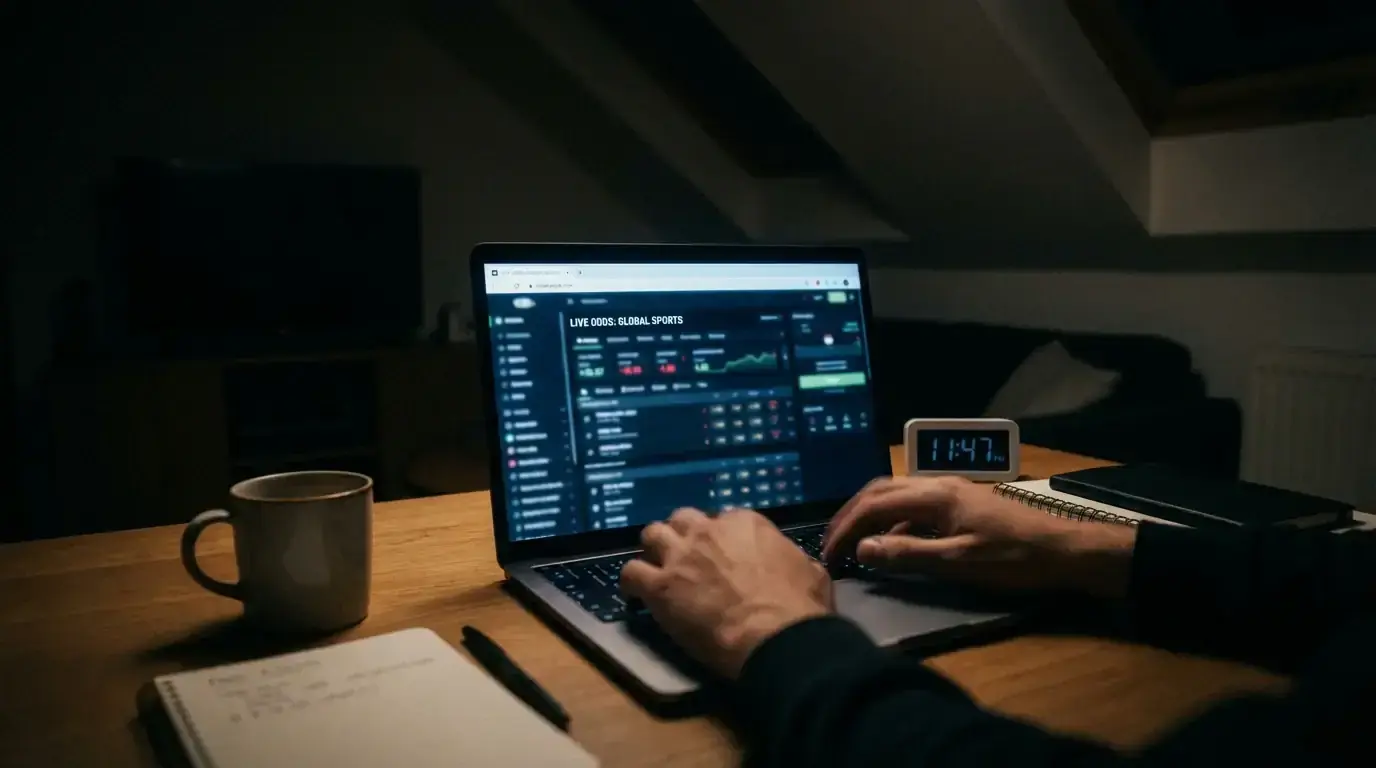
Most MLB games start between 22:00 and 01:00 BST. For a UK bettor, that means baseball is a late-night pursuit — the kind of activity that fits neatly into the hours after the football is done and before sleep takes over. I have turned that scheduling quirk into one of my most profitable betting windows, because live MLB betting at midnight offers something rare: focused attention on a sport where in-play markets are both liquid and inefficient.
In-play betting accounts for a growing share of total sports wagering globally, and baseball’s stop-start structure makes it uniquely suited to live markets. Every half-inning is a discrete unit. Every pitching change resets the game state. Average game duration sits around 2.5 hours, giving you roughly 18 half-innings of decision points across a full nine-inning contest. Compared to the continuous flow of a football match, baseball’s rhythm gives you time to think, evaluate, and act — which is exactly what a disciplined live bettor needs.
Why MLB Is Ideal for In-Play Betting From the UK
The late-night schedule that most UK bettors see as a disadvantage is, in my experience, an edge. At midnight, you are not distracted by other sporting events, social media noise, or the temptation to multi-screen. It is just you and the baseball. That focus is a competitive advantage in a market where many live bettors are placing wagers impulsively between checking their phones.
Baseball’s structure reinforces disciplined live betting in ways that other sports do not. Each at-bat produces a measurable outcome — strikeout, walk, single, home run — and these outcomes are independent events within the context of an inning. You can watch a starting pitcher’s velocity and command through the first two innings and form a reliable read on whether he has his best stuff that night. That information is visible in real time but takes two to three innings to become clear, which means the opening pregame line might have been set on expectations that no longer match reality.
The UK time zone also means you are watching games alongside the East Coast US audience, where the majority of sharp betting action originates. Live lines adjust to this action in real time. If you are observant, you can piggyback on line movements driven by sharps who are reacting to the same in-game information you are seeing.
Pitching Changes, Momentum Shifts, and Live Totals Triggers
The single most valuable moment in MLB live betting is the pitching change. When a manager pulls his starting pitcher and brings in a reliever, the entire dynamic of the game shifts, and live odds adjust accordingly — but not always fast enough.
Here is the pattern I exploit most frequently: a strong starting pitcher keeps the game low-scoring through five innings, and the live total has dropped from, say, 8.5 pregame to 6.5 in-play. Then the starter exits and a middle reliever enters — one with a 4.80 ERA and shaky command. The live total might tick up to 7.0, but if the reliever is genuinely vulnerable, the correction is insufficient. I take the over at 7.0 knowing the expected run environment has spiked with the pitching change. The market catches up eventually, but the window between the pitching change announcement and the full odds adjustment can be fifteen to thirty seconds — enough time to place a bet if you are prepared.
Momentum shifts in baseball are subtler than in football or basketball. A team does not suddenly “take control” in the same visible way. Instead, momentum manifests through pitch count accumulation (a starter laboring through long at-bats, suggesting an early exit), through lineup turnover (the order cycling back to the top, where the strongest hitters sit), and through situational context (runners in scoring position with fewer than two outs). I watch for these convergences rather than relying on gut feeling about which team has “energy.”
Live totals are my primary in-play market because they react to scoring events and pitching changes more dramatically than live moneylines. A two-run home run in the fourth inning does not just change the score — it changes the expected total for the remainder of the game, and the live line adjusts. If the adjustment overshoots (the market assumes the floodgates are open when the pitcher who allowed the home run has been replaced), there is value on the under. If it undershoots (the market assumes normalcy will resume when the bullpen is depleted), the over has value.
Staying Disciplined When Betting Live at 1 AM
I will be honest: discipline at 1 AM is harder than discipline at 1 PM. Fatigue erodes judgment, and the temptation to “make back” a losing pregame slate by firing live bets is real. Nearly half of UK adults participate in some form of gambling, and the accessibility of late-night live markets means the barrier between impulse and action is dangerously low.
I protect myself with three rules that I treat as non-negotiable. First, I set a session bankroll before the first pitch of the night. If that allocation is gone, the session is over — no exceptions, no dipping into the main bankroll. Second, I limit myself to a maximum of three live bets per game. More than that and I am reacting to noise rather than signal. Third, I do not place a live bet within 30 seconds of a scoring event. The immediate aftermath of a run scored is the moment when emotion is highest and the live odds are most volatile. Waiting 30 seconds lets the line settle and lets my rational brain catch up with my gut.
Pre-game preparation is the other half of live-betting discipline. Before the first pitch, I review both starting pitchers’ recent velocity and pitch-mix data, the bullpen availability for both teams, and the weather conditions at the park. I write down two or three specific scenarios that would trigger a live bet — for example, “if Pitcher X’s fastball velocity drops below 92 mph in the third inning, look at the live over.” Having a written plan transforms live betting from a reactive scramble into a structured exercise, and that structure is what makes it sustainable rather than self-destructive. The same discipline applies to every area of MLB betting, but nowhere is it tested as thoroughly as when you are alone with your screen at midnight.
